Experimental Archaeology uses practical reconstruction to try and help answer questions about the past. Reconstructions are not a time machine! They can’t really prove anything in the way that scientific experiements are seen as “proof,” but they can help us to be rigourous in our interpretations.
Shelagh Lewins is the first person we know of to have suggested that the wooden bag handles found at Hedeby and Birka are from bags made of sprang, a braiding process which is worked on a simple loom and creates wide textiles. Lewins also suggested that the bags could have been braided directly on the handles, using them as the tensioning bars in the loom.
We know skins were used for bags on similar handles, and we think it’s a good guess that woven fabric bags were made on similar handles…. but we think the origins of the style may be in these sprang bags.
- these ‘handles’ look strikingly like the tensioning member of a sprang loom
- the way they are made seems to provide some advantages in the braiding stage that most modern sprang looms don’t have
- there are things about these handles that seem to impede their use as handles
Methods
Lewins’ work is beautiful and compelling, but we are hoping to do some more controlled experiments using reproduction bags to try and show, convincingly, whether her theory is correct. The best case scenario is that we find some detail which can somehow be used to reliably distinguish sprang bags from skin or woven ones in the archaeological record. If, for example, sprang bags develop characteristic wear patterns in use, and those patterns can be identified on actual artifacts, it might be a strong signal. More likely, we will be able to demonstrate the possibility that these artefacts could function this way, and and provide evidence about how likely it is that they were or were not.
We plan to experiment with making various types of handles and bags, comparing our results to the archaeological finds, practicing the skills involved to compare working methods, and using the bags to see how they function and wear out.
Questions
As we answer our first questions, we will add more.
- Can you make a sprang bag using this type of handle as a loom part?
- What about bags of skin or woven cloth, can we make those on handles like this?
- Can you use a sprang bag of this type effectively? What about cloth or skin versions?
- How do the different bags function similarly / differently
- How do the different bags wear out? Similarities / differences?
- Can we come up with any better ideas, anything at all that blows the sprang idea out of the water by being significantly better in some way? Maybe these aren’t really handles? Maybe if you make the bags out of spaghetti, it just works WAAAY better? What are the weirdest ideas we can come up with that might disprove our hypothesis?
Phase 1: Getting our feet wet
At the beginning of a project it’s useful to do some experiential archaeology…
Basically that means try it out, learn the skills, practice. Sometimes you end up producing usable, elegant results fairly quickly, like Shelagh’s first bag. Michael and Marks’ first try, on the other hand, well, that came out a little bit small.
Even failures are useful, because that’s how you learn. Also it means you’re trying things that aren’t “safe,” which is an important part of being creative.
Shela gh Lewins’ First Sprang Hedeby Bag
(Our original inspiration)
 Richard Schweitzer’s first try
(his loom is different… that turns out to have been a mistake.)
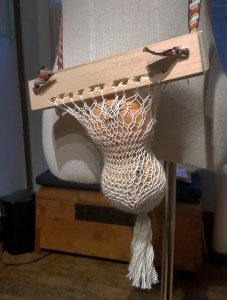 Michael and Mark’s first try
(We don’t talk about this too much. Mike is, after all, very interested in how skill is a more important feature of history than is often recognized.)
(It’s really fine if you only need to carry two onions…)


 Industry Living History